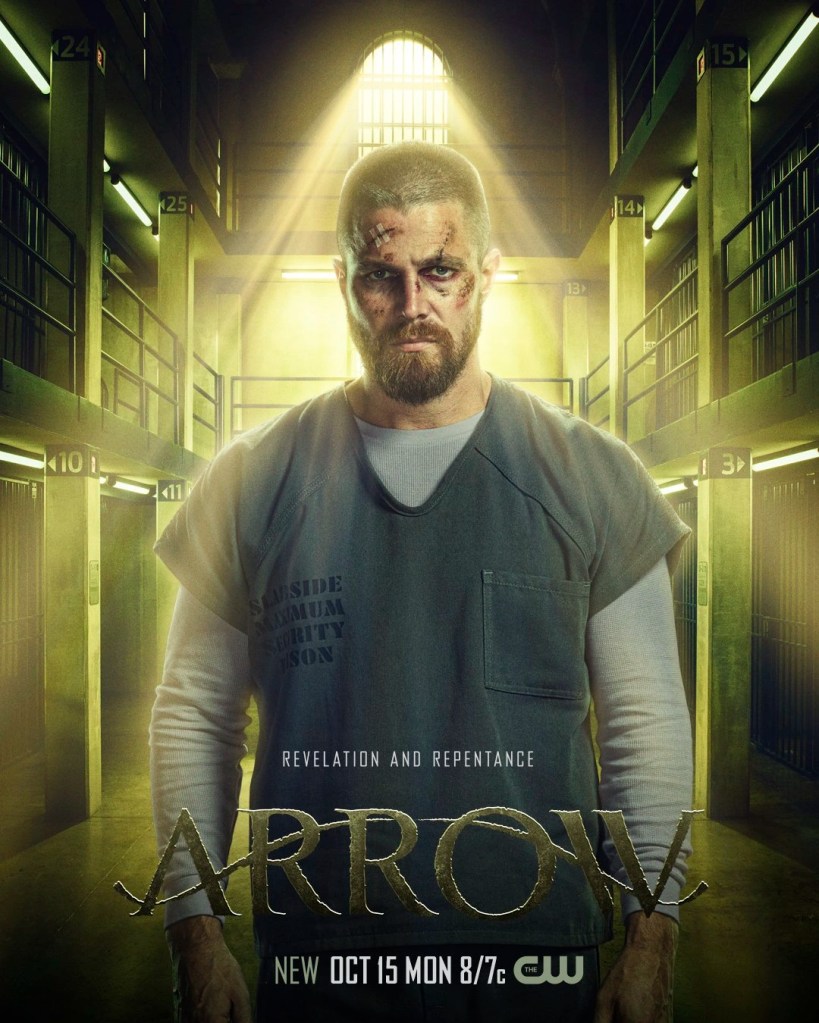
Showrunner Beth Schwartz led the season, featuring Stephen Amell (Oliver Queen), David Ramsey, Emily Bett Rickards (Felicity), Katie Cassidy, Rick Gonzalez, Juliana Harkavy, Echo Kellum, and Colton Haynes returning as Roy Harper. Sea Shimooka debuts as Emiko Queen, Oliver’s secret half-sister and the central antagonist .
The narrative is split into two timelines: the main timeline, in which Oliver is pardoned from prison and deputizes Team Arrow to work with SCPD, confronting Ricardo Díaz, the Longbow Hunters, and ultimately his sister Emiko’s Ninth Circle; and the flash-forward timeline set in 2040, revealing Oliver and Felicity’s children, William and Mia, working to save Star City.
🎯 Season Strengths
1. The Prison Arc: A High-Stakes Feast
The first eight episodes redirect the show’s energy into a gritty, suspense-driven arc with Oliver imprisoned in Slabside Maximum. Highlights include:
- “Inmate 4587” (7×01): Launched with high tension, brutal fight choreography (notably the iconic shower fight), emotional stakes, and gut-punch reveals.
- Oliver’s character evolution: Through episodes like “Slabside Redemption” (7×07), Oliver emerges more morally nuanced, seeing shades of grey and understanding redemption in unlikely allies
The prison arc is widely considered the high point of Season 7—refreshing, intense, and emotionally impactful.
2. Ensemble & Character Arcs
Moving away from the Oliver-centric storytelling of previous seasons, season 7 elevates the supporting cast:
- Felicity, Diggle, Rene, Dinah, Roy, and Laurel all shine. Emily Bett Rickards departs mid-season during “You Have Saved This City,” a finale that ties together many character arcs while spotlighting teamwork
- Katie Cassidy’s Laurel finds redemption through self-awareness and atoning for past misdeeds
- Rene’s run for mayor in the 2040 flash-forwards showcases maturity and growth
Fans appreciated the shift from vigilante independence to cooperation with law enforcement, ageing characters into credible civic roles .
3. Flash-Forward Experimentation
Season 7 replaces the standard flashbacks with a dystopian future arc called “Star City 2040”:
- Episode 16 flips entirely to 2040, introducing William & Mia, as well as a resistance group led by Dinah
- The reveal of Mia Smoak as Blackstar is key, sparking thematic resonance with Emiko’s path
While critics praised its ambition and setup of legacy themes, the timeline was longer planned for Season 8, making the 2040 arc feel under-baked in this season
4. Legacy & Teamwork
The emergence of Emiko as Green Arrow and the theme of one generation passing the torch to the next is a central motif:
- The renewed “List” trope via Emiko parallels Oliver’s iconic quest
- The finale positions Team Arrow’s next generation alongside Oliver—Felicity, Diggle, William, Mia—setting the stage for the final season
These moments were emotionally poignant, emphasizing legacy, family, and unity.
⚠️ Season Weaknesses
1. Narrative Slippage in Parts
After the prison arc, Season 7 loses some momentum. The rise of Emiko and the Ninth Circle feels abrupt:
- Many viewers and commentators find these villains underdeveloped. The Ninth Circle struggled to deliver true menace compared to predecessors like Deathstroke or Prometheus
- Emiko’s betrayal, while intended as a twist, came across as rushed and unearned. A user summed it up: “Emiko was a boring villain… I don’t give a single fuck about the Ninth Circle or the Longbow Hunters”
Many cite the disjointed nature of the mid-to-late episodes, with too many tangential subplots—backdoor pilots, excessive flash-forwards, and spin-off threads—that diluted focus .
2. Flash-Forwards: Great Concept, Underwhelming Execution
The 2040 timeline was conceptually smart, but critics often note it:
- Was too removed from present-day momentum.
- Lacked payoff for the season—much promised in Season 8 instead .
- Felt like mileage was spread thin over too many directions .
3. Longbow Hunters & Ninth Circle Misfire
Blob-heavy subplots surrounding Ricardo Díaz feel repetitive and unsubtle:
- The Longbow Hunters disappear quickly; their potential isn’t fully utilized
- Ninth Circle lacks cohesion, leader development, and emotional stakes compared to past villains .
4. Uneven Episode Tone
After the strong prison arc, Season 7 fluctuates between strong episodes and filler:
- Some episodes (like “Emerald Archer”, “Star City 2040”, “Lost Canary”, “Spartan”, “You Have Saved This City”)
- Others, especially those focused on spin-off setup, feel disconnected or just “there to fill airtime”
Episode 1: “Inmate 4587”
Premise: Oliver’s identity exposed, he’s incarcerated in brutal Slabside Maximum.
- Highlights:
- Immersive prison world-building: gritty surveillance montages, sound design, gangs, and harsh living conditions—the show mirrors classic prison-break arcs.
- Iconic fight choreography: notably the shower brawl, where Oliver fights defensively until unleashed—the raw, visceral energy was widely praised. EW’s ranking placed it in their top 62 episodes ever, commending Arrow’s willingness to “take risks and pull them off” comingsoon.net+15ew.com+15reddit.com+15ew.com.
- Character-limiting: forced isolation from Team Arrow, stripping down to just Oliver vs. prison—Reddit loved this focus: “Easily best part of the season… best arc of the show post‑season 5” reddit.com.
Analysis: Resetting the field, this episode reframes Oliver as desperate and resource-limited, with the season’s strongest opening salvo.
🛡️ Episode 7: “Slabside Redemption”
Premise: The climax of the prison arc, delivering Oliver’s breakout.
- Highlights:
- All‑out action—Oliver takes on police, inmates, and the ever-menacing Díaz, culminating in his escape.
- Use of creative weaponry—a soda-filled pillow, scissors, plus brutal hand-to-hand combat and burning a guard alive. Den of Geek described it as “relentless… more like a short action movie” denofgeek.com.
- No sidekicks, no Overwatch—just Green Arrow, as Reddit users rejoiced: “one‑man show… must be ready to murder again… well paced and superbly structured” reddit.com+14reddit.com+14ew.com+14.
Analysis: This is a season highlight—packed with tension, emotion, and a powerfully staged breakout that leapfrogs Season 7’s reputation among fans.
🎯 Episode 8: “Unmasked”
Premise: Oliver readjusts to life back in Star City; Emiko is unveiled as the new Green Arrow.
- Highlights:
- Emiko’s explosive introduction: stealth attacks, list-crossing mission, and brutality—helps create intrigue around her character ew.com+2tvovermind.com+2reddit.com+2.
- Oliver and team dynamic: adjustment from isolation to teamwork with Rene and Dinah—symbolic return to the core “family” ensemble reddit.com+5ew.com+5ew.com+5.
Analysis: The episode pivots from the prison arc’s intensity to tease new complexities, especially with Emiko’s identity and motivations.
⚔️ Episode 10: “My Name Is Emiko Queen”
Premise: Emiko’s origins and motivations come to light.
- Highlights:
- Emiko’s explanation: crafted from revenge, she operates in her shadowed grief—not unlike Oliver in early seasons birthmoviesdeath.com+9tvovermind.com+9ew.com+9.
- The revenge vs. redemption dichotomy is drawn sharply—showing how Oliver’s hardened years contrast with Emiko’s violence-fueled purpose.
Analysis: This helps humanize Emiko—motivations aren’t just villainous greed but response to abandonment and loss, laying groundwork for her arc.
🧬 Episode 17: “Inheritance”
Premise: Oliver uncovers Emiko’s deceit and her dangerous alignment with the Ninth Circle.
- Highlights:
- Tension and betrayal: Oliver’s loyalty is put to the test as he tailgates Emiko, only for her to betray him by orchestrating the lab attack and destroying ARCHER .
- Emotional character conflict: Oliver trades hope for caution; Emiko reveals layers of trauma tied to their father, offering both depth and contradiction .
- Emiko’s power-up: revealed as the Ninth Circle’s leader—not just a pawn but a threat ew.com+5ew.com+5ew.com+5.
Critique: Some praise increased depth (“shows off Emiko’s smarts… more color”), yet there’s narrative friction—rewriting Emiko’s persona suddenly felt too late or uneven .
💥 Episode 21: “Living Proof”
Premise: The penultimate showdown—Emiko detonates a building; Oliver must decide Emiko’s fate.
- Highlights:
- Heavy psychological drama as Oliver hallucinates Tommy Merlyn, confronting whether he’ll break the “Queen cycle of violence” denofgeek.com+2comingsoon.net+2ew.com+2.
- Emotional stakes: thought Oliver killed Emiko? Nope—it was a vision—but the burden of decision is deep reddit.com+10reddit.com+10denofgeek.com+10.
- Fan reaction: Polarizing—many praised Tommy’s return and moral complexity; others harshly criticized Emiko’s arc: “Emiko is absolute trash… motives are hollow… I hate her” reddit.com+1reddit.com+1reddit.com.
Simultaneously, some felt Oliver’s reluctance to kill was inconsistent:
“poorly written conflict… stakes too high” reddit.comreddit.com.
Analysis: A dramatic but controversial episode; emotionally potent with moral dilemma, yet Emiko’s villainy leaves some viewers unconvinced.
🏁 Episode 22: “You Have Saved This City” (Finale)
Premise: Team Arrow unites to stop Emiko and her bioweapon; Emiko redeems herself at last.
- Highlights:
- Final team unification: director James Bamford’s moving shots frame every team member supported by a robust ensemble—Roy, Dinah, Sirens, Bronze Tiger—“that sense of family is incredibly potent” ew.com+1ew.com+1.
- The message is chosen over violence—ending with Emiko’s self-sacrifice and Oliver’s plea—“Oliver never abandons hope that she can be redeemed” ew.com.
- Classic legacy arc: Emiko’s departure, foreshadows next-gen rise (Mia stepping up), and Oliver/Felicity going underground with baby in tow ew.com+1reddit.com+1.
Critique: Some feel the payoff was rushed—condensed into final act, with major narrative threads rushed or underexplored .
🧩 Thematic Observations
- Legacy & Redemption: Oliver’s journey of rescuing Emiko, despite her betrayals, echoes his own path from revenge to heroism. The finale crystallizes this moral evolution.
- Isolation vs. Team: Prison episodes highlight Oliver’s solitude; by finale, full ensemble unity is celebrated.
- Villain Misdirection: Emiko transitions from mystery archer to full-bad via Ninth Circle, but at times narrative development felt rushed and undercut her potential.
🌟 Final Verdict
Overall Score – Season 7: 7.5/10
- Scope & ambition: daring in structure—jail storyline, flash-forwards, new Green Arrow, and legacy shift.
- Peaks: First third (prison arc), select standout episodes, and the series-caliber finale.
- Valleys: Mid-to-late season drag, underutilized villains, and overstuffed narrative with spin-off clutter.
Pros:
- Reinvigorated tone with prison drama and tighter action.
- Richer spotlight on ensemble characters.
- Emotional legacy and thematic resonance (family, legacy, redemption).
- Set the stage well for the final season.
Cons:
- Under-developed antagonists and rushed narrative arcs.
- Flash-forward payoff too thin in Season 7.
- Episodic inconsistency, especially during spin-off experiments.
✅ Is Season 7 Worth Watching?
Absolutely—for fans of deeper character work, gritty action, and thematic legacy arcs. The prison storyline alone redeems the season, and there’s enough emotional payoff to justify seeing it through. Just manage your expectations: this isn’t a uniformly tight thriller, but a creative, uneven bridge to the series finale.

 One Gay Astronaut
Leave a comment