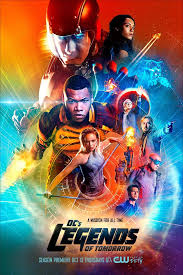
Introduction: The Season That Changed Everything
Season 2 of Legends of Tomorrow stands as one of the clearest examples of a television series learning from its own mistakes in real time. Where the first season was burdened by solemnity, narrative rigidity, and a misplaced belief that legitimacy required darkness, Season 2 makes a decisive and liberating choice: it stops apologizing for what it is. This is the season where Legends realizes that its premise: time-traveling superheroes cleaning up historical disasters caused by other time travelers, is inherently absurd, and that this absurdity is not a weakness to be hidden, but a strength to be embraced.
This creative pivot does not come at the cost of emotional depth. On the contrary, Season 2 demonstrates that sincerity and silliness can coexist, and that character-driven storytelling thrives when freed from the obligation to feel “important” at all times. The season is lighter in tone, but heavier in meaning. It trades epic destiny for personal choice, prophecy for responsibility, and grim inevitability for collective care.
What makes Season 2 remarkable is not merely that it is better than Season 1, but that it redefines the show’s purpose entirely. It transforms Legends of Tomorrow from a spin-off experiment into a fully realized ensemble series with its own voice, rhythms, and philosophy. By the end of the season, the Legends are no longer a group of misfits trying to justify their existence within the Arrowverse. They are, unapologetically, themselves.
A New Mission Statement: From Sacred Timeline to Broken History
The most consequential change Season 2 makes is conceptual. With the Time Masters destroyed at the end of Season 1, the idea of a single, sacred timeline collapses. History is no longer something to be preserved at all costs; it is something already damaged, unstable, and in need of ongoing care.
The Legends’ new mission, to repair temporal aberrations, immediately reframes the show’s relationship with time travel. Instead of pursuing one villain across centuries, the team responds to crises caused by misuse, negligence, or malice. This allows each episode to explore a different genre, historical moment, or ethical dilemma without being shackled to a repetitive central conflict.
Crucially, this shift aligns the narrative structure with the show’s ensemble nature. Responsibility is shared. Failure is expected. Perfection is impossible. The Legends are not saviors chosen by destiny; they are custodians doing damage control in a universe that will never be fully fixed. This ethos becomes the backbone of Season 2’s storytelling.
Episode-by-Episode Analysis
2×01 – Out of Time
The Season 2 premiere functions as a mission statement. The Legends are immediately overwhelmed by multiple aberrations occurring simultaneously across time, forcing them to split up and make imperfect choices. This episode explicitly rejects the idea that history can be neatly managed.
Sara Lance’s emergence as de facto leader is one of the episode’s most important developments. Her leadership style: calm, collaborative, and adaptive, stands in direct contrast to Rip Hunter’s rigid authority in Season 1. The episode also introduces the Justice Society of America, signaling the season’s willingness to engage with comic book history playfully rather than reverently.
Most importantly, Out of Time establishes the season’s central theme: doing the best you can with limited information and accepting the consequences.
2×02 – The Justice Society of America
This episode deepens the show’s interrogation of heroism. The Legends’ interactions with the JSA highlight generational differences in values, methods, and expectations. Where the JSA represents institutionalized heroism, the Legends embody improvisation and moral flexibility.
The episode also introduces Nate Heywood, whose historical knowledge reframes heroism as something contextual rather than absolute. Nate’s presence challenges the idea that history belongs to heroes alone: it belongs to everyone shaped by it.
2×03 – Shogun
Shogun is one of the season’s most visually inventive episodes, blending anime aesthetics with historical revisionism. While lighter on plot progression, the episode exemplifies Season 2’s tonal confidence.
Narratively, the episode reinforces the unpredictability of aberrations and the unintended consequences of time travel. The Legends’ victory feels earned not because they restore history perfectly, but because they mitigate catastrophe.
2×04 – Abominations
This episode marks the formal introduction of the Legion of Doom. Eobard Thawne’s calculated cruelty, Damien Darhk’s theatrical nihilism, and Malcolm Merlyn’s opportunism create an immediate sense of menace.
What distinguishes the Legion is not just their power, but their personality. Their scenes crackle with tension and dark humor, providing a villainous ensemble that mirrors the Legends’ own dysfunction.
2×05 – Compromised
Compromised centers on Rip Hunter’s betrayal and loss of memory, effectively dismantling his authority. This episode is pivotal in repositioning Rip as a flawed participant rather than a commanding force.
Sara’s response to Rip’s actions, firm but compassionate, demonstrates her growth as a leader. She prioritizes the team’s well-being over punishment, reinforcing the season’s emphasis on trust and accountability.
2×06 – Outlaw Country
This Old West–themed episode foregrounds Amaya Jiwe’s internal conflict. Knowing that her village will one day be destroyed, Amaya struggles with the temptation to change her own future.
The episode poignantly explores the cost of historical knowledge. Amaya’s restraint is not framed as obedience to destiny, but as an act of selfless choice.
2×07 – Invasion!
As part of the Arrowverse crossover, Invasion! showcases the Legends at their most adaptable. While the crossover’s scope is vast, the Legends’ contribution emphasizes creativity over raw power.
The episode reinforces the team’s growing cohesion and highlights their ability to function as part of a larger heroic ecosystem without losing their identity.
2×08 – The Chicago Way
This episode explores moral compromise through Rip Hunter’s descent into corruption. His alliance with the Legion of Doom underscores the dangers of absolutism.
Rip’s moral unraveling serves as a cautionary tale about sacrificing ethics for results. The episode treats his choices seriously without stripping him of humanity.
2×09 – Raiders of the Lost Art
A playful homage to adventure cinema, this episode balances humor with character insight. Nate’s enthusiasm contrasts with the darker implications of magical artifacts altering history.
The episode reinforces the idea that curiosity can be both a strength and a liability.
2×10 – The Legion of Doom
This episode fully commits to the villains’ perspective, offering rare insight into their motivations and dynamics. By humanizing the Legion without absolving them, the show deepens its moral complexity.
The Legends’ absence in much of the episode underscores the idea that heroism is not inevitable: it must be actively chosen.
2×11 – Turncoat
Set during the American Revolutionary War, Turncoat examines loyalty and betrayal. Sara’s decision-making under pressure highlights her ability to balance pragmatism with principle.
The episode also allows secondary characters moments of growth, reinforcing the ensemble’s strength.
2×12 – Camelot/3000
This episode blends Arthurian myth with science fiction, epitomizing the season’s genre fluidity. While intentionally absurd, the episode explores themes of idealism and leadership.
The Legends’ rejection of prophecy-driven narratives mirrors the show’s broader rejection of destiny as a guiding force.
2×13 – Land of the Lost
This episode centers on Mick Rory’s struggle with identity and purpose. His fear of abandonment and inadequacy is treated with surprising tenderness.
Mick’s development here solidifies him as one of the season’s most quietly compelling characters.
2×14 – Moonshot
Amid Cold War paranoia, Moonshot interrogates trust and sacrifice. The Legends’ willingness to rely on one another reflects their evolution into a genuine family.
The episode’s tension arises not from external threats alone, but from internal doubt.
2×15 – Fellowship of the Spear
The penultimate episode builds momentum toward the finale while emphasizing collaboration. The Spear of Destiny represents absolute power, but the episode frames its pursuit as morally fraught.
The Legends’ debates over its use highlight their commitment to ethical restraint.
2×16 – Aruba-Con
The finale brings the season’s themes to a satisfying conclusion. Rather than relying on spectacle, the resolution emphasizes choice, sacrifice, and unity.
Sara’s leadership, Rip’s humility, and the team’s cohesion culminate in a victory that feels earned because it aligns with the show’s values.
Character Arcs Revisited
Sara Lance: Leadership as Care
Sara’s arc across Season 2 is defined by balance. She leads without dominating, cares without controlling, and fights without losing herself. Her leadership philosophy: trust the team, accept imperfection, protect people over timelines, becomes the show’s moral center.
Rip Hunter: Learning to Let Go
Rip’s journey from authority figure to humbled participant is one of the season’s most significant transformations. By relinquishing control, Rip finally integrates into the ensemble rather than overshadowing it.
Nate Heywood: History as Human Story
Nate reframes history as lived experience rather than abstract fact. His growth into Steel parallels his emotional maturation, making him one of the season’s most relatable figures.
Amaya Jiwe: Strength Through Restraint
Amaya’s arc explores the pain of loving a future you cannot save. Her choices emphasize agency over inevitability.
Mick Rory: Belonging Without Redemption Theater
Mick’s development rejects simplistic redemption narratives. He is not transformed into a hero; he is accepted as he is, flaws and all.
Themes: Why Season 2 Works
Season 2 succeeds because it understands that meaning comes from connection rather than control. Choice replaces destiny. Community replaces hierarchy. Humor replaces defensiveness.
The show accepts that timelines can be repaired, but people cannot be erased or rewritten without cost.


 One Gay Astronaut
Leave a comment