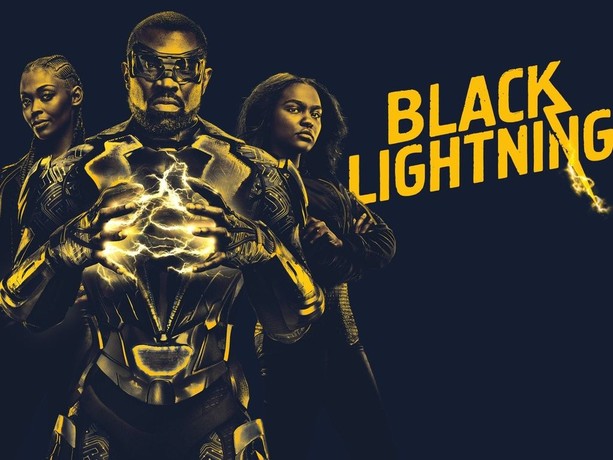
“Justice… like lightning… ever should appear.”
Introduction
When Black Lightning premiered in 2018, it carried a weight and a promise that no other CW superhero series had attempted. The Arrowverse already existed in full swing: Arrow had moved deep into its late-stage brooding vigilantism, The Flash was in its speedster-of-the-year era, and Supergirl balanced optimism with sociopolitical allegory. Yet Black Lightning arrived as an outlier: it was not a spinoff, not tonally aligned with its network siblings, and not beholden to crossover spectacle. Instead, it launched with a singular identity—intimate, urgent, political, grounded, and culturally specific in a way that no other superhero series had dared to be.
Unlike the origin stories of most caped heroes, Black Lightning Season 1 begins with absence. Jefferson Pierce has already retired from vigilantism. The city of Freeland is spiraling downward. Violence isn’t hypothetical; it’s embedded in institutions, schools, streets, and neighborhoods. When the series opens, Jefferson is a man trying to keep the last sliver of hope alive, through education, fatherhood, and community leadership, not through fists or thunderbolts. That central tension: the pull between nonviolent leadership and the seductive necessity of violence, defines the entire season.
Season 1 stands out not merely because of the story it tells, but how it tells it. It is a show about power in the broadest possible sense: political power, state power, family power, community power, and the immense weight of superhuman power. It is a superhero narrative filtered through the lens of generational trauma, systemic racism, and the long struggle for liberation. In this way, Black Lightning Season 1 is as much a drama about America as it is about metahumans.
This review explores the season’s narrative structure, character arcs, social themes, direction, performances, and cultural legacy. It also breaks down why this first season continues to stand as one of the most cohesive, emotionally potent debuts in modern superhero television.
I. Worldbuilding and Tone: Freeland as a Living, Breathing Character
Before diving into character arcs, the first achievement of Black Lightning Season 1 is the construction of Freeland itself.
Freeland Is Not a Backdrop, It’s the Point
Unlike other CW cities, Star City, Central City, and National City, Freeland is not stylized into vague urban universality. It is distinctly African-American, distinctly Southern in texture, and distinctly shaped by the political pressures placed on Black communities. The music, the fashion, the protests, the barbershops, the classrooms, the churches, all feel organic, not manufactured. The city is vibrant but wounded, alive but afraid of its own institutions.
Freeland is introduced as:
- A city plagued by gang violence
- A target of government surveillance
- A community subjected to state aggression
- A place where hope is threatened but not extinguished
It is a brilliant narrative choice to treat the city not as a fictional sandbox for superhero antics, but as an ecosystem. Every storyline, from the 100 gang violence to the police brutality scenes, anchors itself in the reality of how people live, love, survive, and resist. The cinematography reinforces this: handheld shots, warm tones punctuated by cold blues in scenes with police or ASA forces, and frequent tight framing to evoke claustrophobia.
The Aesthetic Language of the Show
The show embraces:
- Jazz-infused scoring
- Trap, neo-soul, and hip hop needle drops
- A dark, moody color palette with rich golds and blues
- Slow pans during emotional moments
- Visual motifs of storms, rain, and electricity
The look and sound of Black Lightning Season 1 announce that it aims to be more prestige drama than camp superhero show. And for the most part, it succeeds.
II. Jefferson Pierce: The Hero Who Quit, and Why That Matters
A Middle-Aged Protagonist in a Genre Obsessed with Youth
Jefferson Pierce is one of the most refreshing protagonists in superhero television. He is older, tired, and emotionally scarred. He is not learning powers: he is surviving them. Unlike Oliver Queen’s violent compulsion or Barry Allen’s bright heroism, Jefferson sees his powers as both a blessing and a generational curse. Cress Williams delivers a performance layered with maturity and vulnerability.
Jefferson is:
- a father
- a community leader
- an ex-husband still in love with his wife
- a man wrestling with past trauma
- a superhero who deeply resents what his powers cost him
This complexity grounds the entire season.
The Internal Conflict That Defines the Narrative
Jefferson faces a moral crisis:
- If he uses violence, he risks becoming a part of the cycle that plagues Freeland.
- If he refuses, he risks letting the city he loves collapse.
Unlike superhero narratives where the hero embraces their powers as destiny, Jefferson’s story is one of reluctance. His powers are not wish-fulfillment—they’re the embodiment of burden. The pilot episode frames this flawlessly: Jefferson returns to heroism not because he wants to, but because his daughter is kidnapped. His reawakening is fueled by necessity, not destiny.
Jefferson as Principal Pierce
His identity as a principal is perhaps more important than his identity as a superhero. At Garfield High, Jefferson:
- Protects students from police overreach
- Mediates gang conflicts
- Offers structure and stability
- Champions education as resistance
One of the most resonant messages of Season 1 is that Black heroes already exist—in schools, in homes, in neighborhoods. Jefferson’s heroism without the suit is often more impressive than his heroism with it.
III. Lynn Pierce: Morality, Science, and the Cost of Loving a Hero
Lynn is one of the rare superhero spouses who is neither sidelined nor reduced to caricature. She is not merely the “worried wife.” She is:
- a neuroscientist
- a moral philosopher
- a co-parent
- a woman with boundaries
- someone who loves Jefferson but refuses to be consumed by his mission
Christine Adams grounds Lynn with intelligence and heartbreak. Her concerns are not melodramatic: they are legitimate ethical positions.
Lynn as Moral Compass
Lynn represents:
- Consequences
- Accountability
- Science over vigilante justice
- Healing over violence
One of the strongest scenes of the season is her telling Jefferson, “Every time you go out there, you come back a little less whole.” This encapsulates her emotional conflict: loving a hero means loving a man who may not survive himself.
Supporting but Never Subordinated
Lynn’s arc intersects directly with:
- The Green Light crisis
- Jefferson’s identity crisis
- Anissa’s awakening
- Jennifer’s fear
- Gambi’s secrets
She is woven into the narrative rather than orbiting it.
IV. Anissa Pierce: Thunder’s Coming-of-Age and the Politics of Heroism
Anissa Pierce’s arc is one of the most compelling origin stories in superhero television—not because of her powers, but because of what her awakening represents.
A Black Queer Hero Breaking Ground
Anissa is a bold, unapologetic, queer Black woman whose activism predates her powers. Unlike Jefferson, her heroism begins politically, not supernaturally. She is:
- a medical student
- a community organizer
- a scholar
- an activist shaped by historical and modern Black liberation movements
Her identity is not a subplot, it is a thematic pillar.
From Protester to Protector
Her arc follows a trajectory:
- Standing up for her classmates
- Joining protests
- Challenging authority
- Discovering her strength
- Reframing her activism through superhuman ability
Her journey parallels historical shifts from nonviolent protest to armed self-defense—a conversation the show handles with maturity.
The Fight With the Racist Store Clerk
One of Season 1’s standout sequences is Anissa’s confrontation with a racist shopkeeper. It’s powerful not because she wins, but because the scene externalizes the microaggressions and aggressions Black women face. When Anissa discovers her ability during this moment, the symbolism is unmistakable: her body becomes a site of resistance.
Thunder’s Debut: A Visualization of Power
Her suit, her training, her ideological clashes with Jefferson—each step is grounded in a generational battle between “respectability politics” and “radical resistance.” Their father-daughter dynamic becomes a philosophical debate about how change happens.
V. Jennifer Pierce: Electricity as Burden, Not Fantasy
Jennifer’s arc is the emotional counterpoint to Anissa’s empowerment. Where Anissa sees possibility, Jennifer sees loss.
A Teenage Girl Who Wants Normalcy
Jennifer is the rare teenage superhero character who reacts realistically:
- She panics
- She feels trapped
- She fears inheriting her father’s burdens
- She rejects vigilante culture
Her arc gives voice to the generational trauma of families where heroism is legacy but also curse.
Fear, Not Wish-Fulfillment
Jennifer’s powers manifest as anxiety. Her first accidental lightning burst is terrifying, not triumphant. The show refuses to glamorize her transformation. Instead, it frames it as:
- a loss of control
- a loss of autonomy
- a reshaping of identity she never asked for
China Anne McClain delivers the season’s most emotionally nuanced performance.
VI. Tobias Whale: A Villain with Operatic Gravitas
Tobias Whale is one of the most compelling live-action comic villains in years.
Krondon’s Mesmerizing Performance
Marvin “Krondon” Jones III embodies Tobias with icy charisma. He is:
- cultured
- intelligent
- cruel
- strategic
- quietly sadistic
His albinism is part of his character without being his character. The show emphasizes his experiences with racism, particularly internalized racism within the Black community, without demeaning or pathologizing him.
Philosophical Antagonism
Tobias is Jefferson’s ideological opposite:
- Jefferson believes in community uplift; Tobias believes in domination.
- Jefferson champions education; Tobias champions manipulation.
- Jefferson protects Freeland; Tobias preys on it.
Every confrontation between them is electric not because of special effects, but because their rivalry embodies a clash between two models of Black masculinity and leadership.
The 100 Gang and the Infrastructure of Violence
Tobias isn’t merely a villain, he is the architect of Freeland’s suffering. His gang, the 100, acts as a systemic force of destabilization. Unlike cartoonish villain organizations, the 100 feels frighteningly real: its recruitment, its economics, its violence, its loyalty structures.
VII. Peter Gambi: Secrets, Betrayal, and the Ethics of Legacy
Gambi’s role oscillates between mentor, enabler, and architect of lies.
The Complicated Father-Figure
Gambi is part Alfred, part Nick Fury, part unreliable narrator. His love for Jefferson is genuine, but his manipulation is equally real. His past involvement with the ASA creates an intergenerational chain of secrets that will ripple through every character.
Gambi represents:
- covert war
- surveillance culture
- the paranoia of whistleblowers
- moral ambiguity in liberation movements
His arc adds layers of spy-thriller intrigue to the season.
VIII. Core Themes of Season 1
1. Systemic Racism and State Violence
Unlike other superhero shows that treat racial injustice metaphorically, Black Lightning names it:
- Police brutality
- Racial profiling
- Militarization of Black neighborhoods
- Biopolitics and experimentation on Black bodies
The show doesn’t sanitize these topics.
2. The Cost of Heroism on Families
Every Pierce suffers because Jefferson is Black Lightning.
The show repeatedly asks: Is one man’s vigilantism worth the pain it causes his family?
This question has no easy answer, and that is the point.
3. Education as Liberation
Garfield High is a battleground for:
- hope
- empowerment
- resistance
- community building
Jefferson’s speeches, hallway interventions, and faculty interactions highlight the show’s belief in schools as pillars of liberation movements.
4. Activism Versus Vigilantism
Anissa and Jefferson embody two traditions:
- Jefferson: respectability politics, institutional change
- Anissa: direct action, militant resistance
The tension is intergenerational and ideological.
5. Trauma and Reclamation of Power
The show visualizes Black trauma through:
- powers
- flashbacks
- community storytelling
- intergenerational echoes
Superpowers are metaphors for survival mechanisms.
IX. Structure and Pacing: A Season Without Fluff
Unlike other CW shows that stretch arcs across 23 episodes, Black Lightning Season 1 is tight at 13 episodes.
Tight Pacing
The narrative is compact:
- No unnecessary subplots
- No filler villains
- Every episode advances emotional stakes
The momentum builds steadily toward the ASA conspiracy reveal.
X. The ASA Conspiracy: Science Fiction Rooted in Real History
The Green Light storyline parallels:
- Tuskegee
- COINTELPRO
- Government experimentation on marginalized groups
Science fiction becomes historical allegory. The season finale’s revelation that Freeland’s suffering was orchestrated by a state agency recontextualizes every act of violence in the season.
XI. The Season Finale: Legacy, Loss, and Lightning
The finale brings the family together in full force:
- Jennifer’s powers surface
- Anissa stands beside her father
- Lynn confronts her trauma
- Gambi’s loyalties stabilize
- Tobias steps into broader power
The emotional climax is not the final fight, but the family’s collective awakening.
XII. Performances
- Cress Williams is monumental: gentle, fierce, exhausted, hopeful.
- China Anne McClain delivers raw vulnerability.
- Nafessa Williams radiates power and purpose.
- Christine Adams anchors the narrative morally and emotionally.
- Krondon is magnetic, chilling, unforgettable.
XIII. Criticisms and Minor Flaws
No season is perfect. Minor issues include:
- Occasional uneven visual effects
- Some early episodes repeat the “Jefferson resists returning to heroism” beat too often
- The Lawanda subplot is emotionally potent but slightly rushed
However, none of these detract significantly from the season’s overall impact.
Conclusion: A Landmark Season of Television
Black Lightning Season 1 is not just an excellent superhero season, it is an essential piece of Black storytelling in modern television. It succeeds because it dares to:
- root itself in real history
- center Black family life
- interrogate violence and power
- explore liberation, survival, and resistance
- portray authentic Black experiences without compromise
It is a radical blend of superhero drama, sociopolitical critique, and family saga.
Season 1 stands proudly as one of the strongest first seasons in the superhero genre: emotionally resonant, politically sharp, beautifully acted, and culturally necessary.
If the Arrowverse had an artistic peak, it was here.

 One Gay Astronaut
Leave a reply to timetravelinner1894bda68b Cancel reply