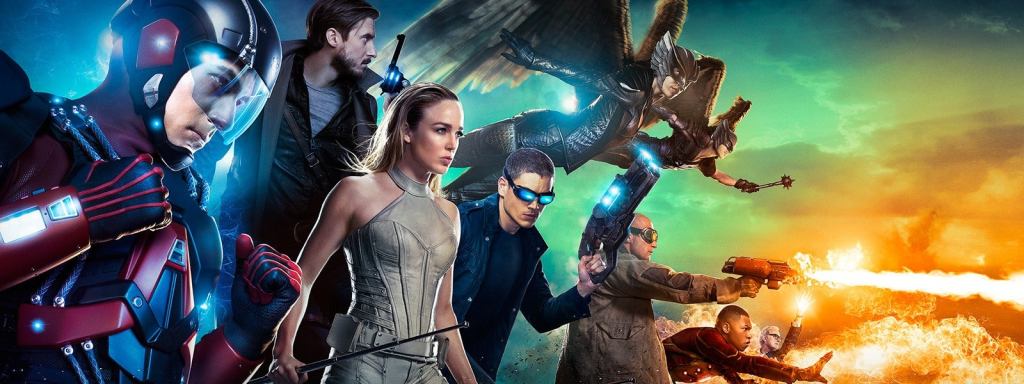
Introduction: The Arrowverse’s Wild Card
DC’s Legends of Tomorrow premiered in January 2016 as the Arrowverse’s most experimental and uncertain project. Where Arrow had established itself as a grounded, often grim vigilante drama, and The Flash embraced optimism, speed, and science-fiction spectacle, Legends of Tomorrow set out to be something far harder to define. It was neither a traditional superhero show nor a clean genre piece, but a hybrid: a time-travel adventure, an ensemble drama, and a narrative recycling bin for characters who did not quite fit anywhere else.
Season 1 is therefore best understood not as a polished debut, but as an act of tonal and structural experimentation. The show attempts to justify its existence within a crowded television universe by promising scale: history itself is at stake, and novelty, no other Arrowverse series could jump from 1975 to 2166 within a single episode. At the same time, it carries the baggage of its origins as a spin-off, inheriting half-developed arcs, unresolved trauma, and audience expectations shaped by other shows.
The result is a season that is deeply inconsistent but rarely boring. Legends of Tomorrow Season 1 is often clumsy, sometimes frustrating, occasionally compelling, and unintentionally revealing about the limits of Arrowverse storytelling at the time. A balanced review must acknowledge that while the season frequently fails on its own terms, it also lays the groundwork for one of the franchise’s most distinctive evolutions.
The Core Premise: Saving History by Breaking It
The foundational idea behind Legends of Tomorrow is deceptively simple. Rip Hunter, a rogue Time Master from the future, recruits a team of heroes and villains to stop immortal despot Vandal Savage from conquering the world and murdering Rip’s family. This mission spans centuries, granting the show narrative permission to explore historical periods, speculative futures, and moral paradoxes inherent in time travel.
On paper, this is a rich and flexible premise. Time travel inherently raises questions about determinism, responsibility, and unintended consequences. The notion that history must sometimes be allowed to suffer for the greater good offers fertile ground for ethical dilemmas. Additionally, framing the team as expendable “legends” whose deaths would not disrupt the timeline introduces an intriguing existential tension.
In practice, Season 1 struggles to translate these ideas into compelling television. Time travel often functions as aesthetic flavor rather than narrative substance. Historical settings are frequently interchangeable backdrops rather than meaningful influences on character or plot. The show rarely lingers on the ripple effects of the team’s actions, opting instead to reset the board episode by episode.
This disconnect between concept and execution becomes one of the season’s defining weaknesses. The show gestures toward grand philosophical questions but rarely commits to exploring them in depth. As a result, the premise feels underutilized, its potential constrained by a rigid central storyline.
Vandal Savage: An Immortal Problem
Every serialized narrative is shaped by its antagonist, and Season 1’s greatest structural burden is Vandal Savage. As an immortal being who has manipulated history for millennia, Savage should be a thematically resonant foil for a time-traveling team. Immortality, after all, invites questions about stagnation, power, and moral decay.
Unfortunately, Savage is written with surprising simplicity. Rather than exploring the psychological toll of eternal life or the ideological logic behind his conquests, the season portrays him largely as a static tyrant. His goals rarely evolve, and his personality remains fixed across centuries. This lack of depth makes him ill-suited for a 16-episode arc.
Narratively, Savage’s immortality creates repetitive storytelling. The Legends confront him, fail to kill him, retreat, and vow to try again later. Because Savage cannot be permanently defeated until the finale, most encounters feel inconsequential. Tension dissipates, replaced by a sense of narrative stalling.
The Hawks’ reincarnation mythology ties them directly to Savage, but even this connection fails to deepen him as a character. Instead of enriching Savage’s motivations, the mythology often reduces him to a plot device, a necessary obstacle rather than a compelling presence.
Rip Hunter: Tragedy Without Trust
Rip Hunter is positioned as Season 1’s protagonist and emotional linchpin. His backstory, watching his wife and son die at the hands of Savage, provides a clear motivation, and Arthur Darvill brings earnest intensity to the role. Rip’s grief is palpable, and his obsession with changing history is understandable.
However, Rip is also one of the season’s most problematic elements. His leadership style is defined by secrecy and manipulation. He lies to the team about their importance to history, withholds crucial information, and consistently prioritizes his personal vendetta over collective well-being. While these traits could form the basis of a compelling antihero arc, the season rarely interrogates them with sufficient rigor.
Instead, Rip’s flaws often generate artificial conflict. Characters argue because Rip refuses to communicate, not because of genuine ideological differences. When his lies are revealed, consequences are fleeting. The narrative seems torn between portraying Rip as tragically flawed and insisting on his moral authority.
This ambiguity weakens his arc. Rip is most effective when he is challenged, particularly by Sara Lance, but the season seldom allows these challenges to fundamentally reshape him. As a result, Rip often feels out of sync with the show’s ensemble focus, a remnant of a more traditional hero-centered narrative struggling to coexist with a team-driven format.
The Ensemble Concept: Strength in Numbers, Weakness in Focus
If Season 1 falters in its central villain and protagonist, it finds renewed energy in its ensemble. The Legends are a deliberately mismatched group: assassins, scientists, criminals, idealists, and warriors bound together by circumstance rather than trust. This dynamic is the show’s greatest asset, even when unevenly utilized.
Sara Lance: The Moral Compass Forged in Darkness
Sara Lance emerges as the season’s most fully realized character. Her journey from traumatized assassin to reluctant leader is both credible and compelling. Unlike Rip, Sara’s authority is earned through experience rather than imposed by narrative fiat.
Sara’s defining trait is moral clarity born of suffering. She understands the cost of violence and the weight of choice, making her uniquely suited to navigate the ethical complexities of time travel. Caity Lotz’s performance balances vulnerability and strength, allowing Sara to function as both emotional anchor and pragmatic strategist.
Importantly, Sara’s arc is not about redemption in the conventional sense. She is already on that path when the season begins. Instead, her story explores self-forgiveness and responsibility, positioning her as the character most capable of leading the Legends into something greater than Rip’s personal crusade.
Ray Palmer: Idealism in a Cynical World
Ray Palmer represents the season’s aspirational heart. His optimism, intelligence, and belief in second chances contrast sharply with Rip’s fatalism and Snart’s cynicism. Brandon Routh imbues Ray with sincerity that prevents him from becoming cloying.
However, Ray’s role in Season 1 is underdeveloped. While thematically important, he lacks a strong personal arc tied to the central conflict. His grief over his fiancée’s death is acknowledged but rarely explored in depth. As a result, Ray often feels like a moral commentator rather than an active narrative driver.
Still, Ray’s presence is essential. He articulates the show’s belief in redemption and growth, even when the narrative itself struggles to live up to those ideals.
Firestorm: Generational Dialogue and Mutual Dependence
The Firestorm pairing of Martin Stein and Jefferson Jackson stands out as one of Season 1’s most consistently effective storylines. Their relationship is rooted in generational conflict, mutual distrust, and eventual respect.
Martin’s guilt over past mistakes and Jefferson’s fear of losing control create tangible emotional stakes. Unlike other arcs, Firestorm’s storyline evolves organically over the season, culminating in a partnership defined by consent and cooperation rather than necessity.
Victor Garber and Franz Drameh share natural chemistry, grounding their fantastical powers in human connection. Their arc exemplifies what Legends of Tomorrow does best when it prioritizes character over plot mechanics.
Hawkgirl and Hawkman: Myth Without Emotion
The Hawks are Season 1’s most conspicuous failure. Despite being central to the Vandal Savage mythology, they are thinly characterized and emotionally distant. Their reincarnation romance is conveyed through exposition rather than lived experience, making it difficult to invest in their tragedy.
Kendra Saunders’ struggle with her past lives has potential, but the writing rarely allows her to process this trauma meaningfully. Carter Hall fares worse, defined almost entirely by destiny and aggression. Together, they feel more like mythological concepts than people.
Their prominence in the narrative ultimately undermines the season, as viewers are asked to care deeply about characters the show has not adequately developed.
Leonard Snart and Mick Rory: Criminals with Clarity
Leonard Snart and Mick Rory bring sharp contrast to the team’s moral rhetoric. Snart, in particular, benefits from Legends’ looser ethical framework. His code: self-serving yet principled, feels honest in a way Rip’s authority does not.
Wentworth Miller’s performance adds layers of irony and restraint, making Snart one of the season’s most compelling figures. Mick Rory, while less nuanced, serves as a blunt reminder of the costs of marginalization and rage.
Together, the Rogues challenge the assumption that heroism is inherently superior to criminality, enriching the show’s exploration of redemption.
Tone: An Identity Crisis in Motion
Season 1 is tonally unstable. Episodes oscillate between grim determinism and lighthearted adventure, often within the same hour. Jokes interrupt dramatic beats, while heavy exposition drags down moments meant to feel fun.


Leave a Reply